
American reactors need American fuel: the enrichment buildout
Key takeaways
- Urenco USA started production in its sixth new centrifuge cascade in New Mexico in October, part of 700,000 SWU of new capacity planned for 2025 to 2027.
- General Matter applied for an NRC license to build an enrichment plant at Paducah, Kentucky, aiming for production by 2030, ahead of a full ban on Russian enriched uranium imports in 2028.
- Centrus bought Westerman, a key centrifuge component supplier, for about $116 million to secure its supply chain.
- Enrichment is a chokepoint for nuclear energy, and the buildout creates openings in components, manufacturing, logistics and workforce.
A reactor is only as reliable as its fuel supply. For years the US has relied partly on imports, including from Russia, to enrich the uranium its reactors burn. That is changing. A string of announcements in October shows enrichment being rebuilt at home, and we think it is one of the clearest examples of what American energy sovereignty looks like in practice.
What happened in October?
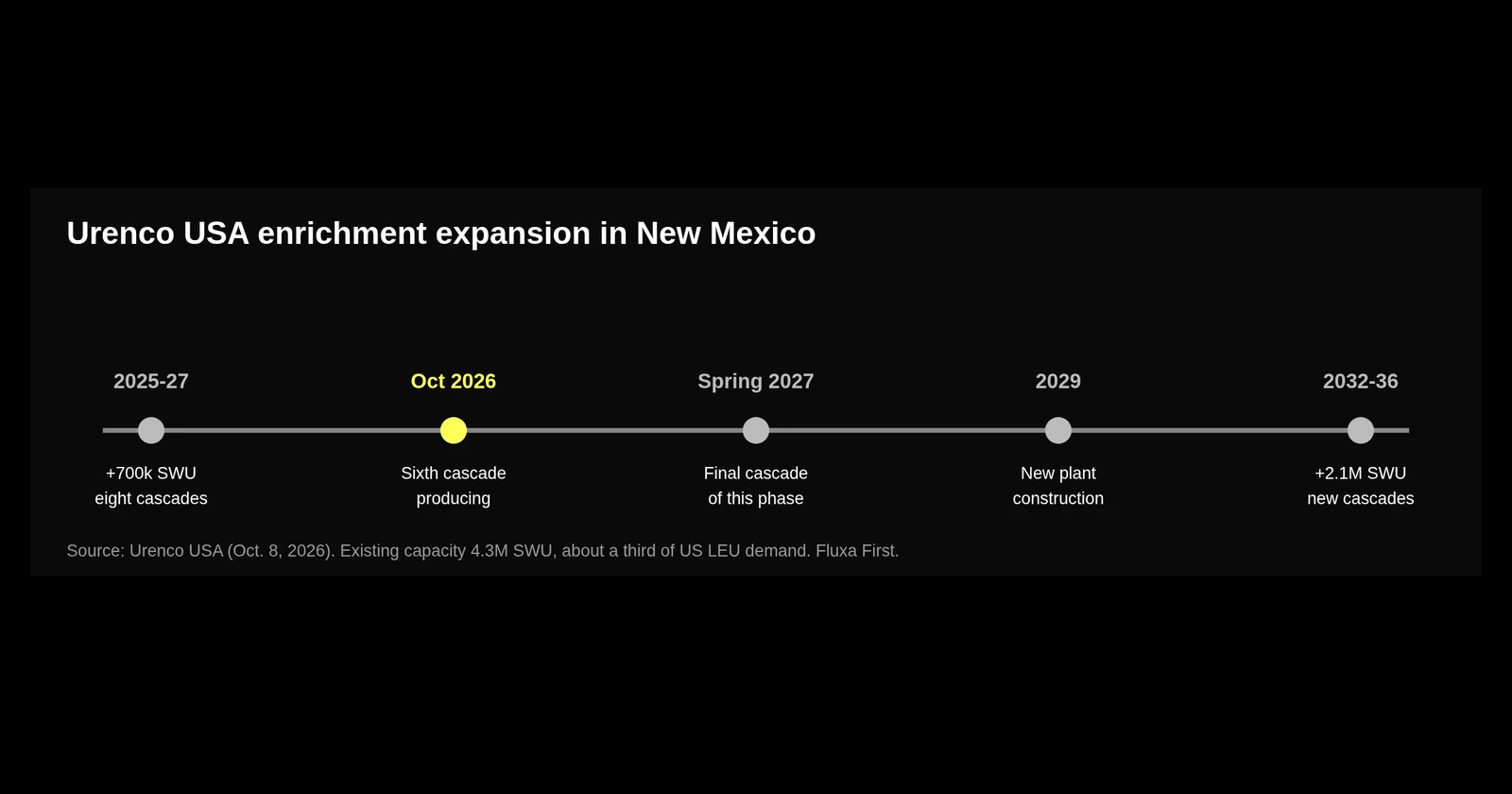
New capacity in New Mexico. On October 8, Urenco USA started production in its sixth new cascade at its National Enrichment Facility in Eunice. It is adding 700,000 separative work units, or SWU, of capacity between 2025 and 2027 through eight new cascades, with a seventh due later this year and the last in spring 2027. Its six installed cascades can produce more than 500,000 SWU a year. Urenco said its existing 4.3 million SWU of capacity can meet about a third of current US demand for low-enriched uranium, and that it plans to start building a new plant in 2029, adding 2.1 million SWU with first cascades in 2032.
A license application in Kentucky. General Matter applied in late September for a Nuclear Regulatory Commission license to build an enrichment plant at the former Paducah gaseous diffusion site, and related documents became public on October 5, Nuclear Newswire reported. The company plans to produce both low-enriched uranium and HALEU, has asked for expedited review and has kept its enrichment technology confidential as a trade secret. Its environmental report notes that Russia supplied about 20% of US enrichment needs until recently and that a full ban on Russian imports takes effect in 2028. General Matter and its Paducah neighbor Global Laser Enrichment both aim to begin production by 2030.
A supply chain acquisition in Ohio. On October 19, Centrus Energy announced it had acquired Westerman Holdings, one of its largest suppliers, for about $116 million in cash and stock. Westerman makes centrifuge casings and other major centrifuge components, along with nuclear-grade products such as UF6 cylinders, and has about 400 employees at four facilities in Ohio, Oklahoma and Wyoming. Centrus said bringing Westerman in-house secures a critical supplier for its planned enrichment expansion.
Where does federal support fit?
In January, the Department of Energy awarded $2.7 billion in enrichment task orders: $900 million each to American Centrifuge Operating, a Centrus subsidiary, and General Matter for HALEU capacity, and $900 million to Orano Federal Services to expand LEU capacity. It also awarded $28 million to Global Laser Enrichment for next-generation technology. DOE said the awards are paid against strict milestones.
Why is fuel a sovereignty issue?
Nuclear power is often described as domestic energy. The reactors are. The fuel chain is more complicated. Mining, conversion, enrichment and fabrication each have their own chokepoints, and enrichment is one of the hardest to build: plants need NRC licenses, specialized equipment and years of construction, as the timelines above show.
The 2028 ban on Russian enriched uranium sets a deadline. Advanced reactors add another layer, because many designs need HALEU, a fuel DOE is funding new domestic supply chains to produce. Without domestic enrichment, a new generation of American reactors would depend on foreign fuel. We wrote about the reactor side of this story in our post on advanced nuclear permits and microreactors.
What does the Centrus deal tell us?
The Westerman acquisition is a small deal with a big lesson. When a company is about to spend billions expanding capacity, the weak point is often a supplier with a few hundred skilled workers and specialized equipment. Centrus chose to own that supplier rather than risk it. The same pattern shows up across the industrial base, from engine makers buying castings capacity to defense companies bringing sensors in-house.
Where are the opportunities for builders?
| Part of the fuel chain | What it needs |
|---|---|
| Centrifuge and plant components | Precision fabrication, casings, rotors, vacuum and controls |
| Cylinders and transport | Certified containers, logistics, tracking |
| Inspection and quality | Non-destructive testing, digital records for regulators |
| Construction and licensing | Faster engineering documentation and project delivery |
| Workforce | Training for operators, technicians and welders |
Most of these are not nuclear physics. They are manufacturing, logistics and software businesses that serve a demanding customer. The barriers are quality systems, certifications and patience with long project timelines.
How we see it at Fluxa First
The fuel chain is a strong example of where focused companies matter to American industry and energy independence. The large enrichment players are funded. What they need around them are reliable suppliers, service providers and tools that help them build on schedule.
Those suppliers tend to be durable businesses with long contracts and few competitors. They grow on revenue and fit well with studio-aligned capital that rewards steady performance rather than a single exit. Rebuilding American fuel supply will take a decade of execution. The companies that help do it will be worth owning for longer than that.
Frequently asked questions
Why does the US need more uranium enrichment?
Enrichment raises the share of fissile uranium-235 so uranium can fuel reactors. The US has relied partly on imports, including from Russia, and a full ban on Russian enriched uranium imports takes effect in 2028. Many advanced reactor designs also need high-assay low-enriched uranium, or HALEU, and DOE is funding new domestic capacity to produce it. Building domestic enrichment reduces dependence on imports.
What is the difference between LEU and HALEU?
Low-enriched uranium, or LEU, fuels today’s commercial reactors and is enriched to up to 5% uranium-235. High-assay low-enriched uranium, or HALEU, is enriched to above 5% but below 20% and is needed by many advanced reactor designs, according to the Energy Department and the NRC. Both are far below weapons-grade levels.