
Complementary founding teams: how we use the Big Five to build them
Key takeaways
- The Big Five model (openness, conscientiousness, extraversion, agreeableness and neuroticism) describes temperament as positions on five spectra rather than fixed types.
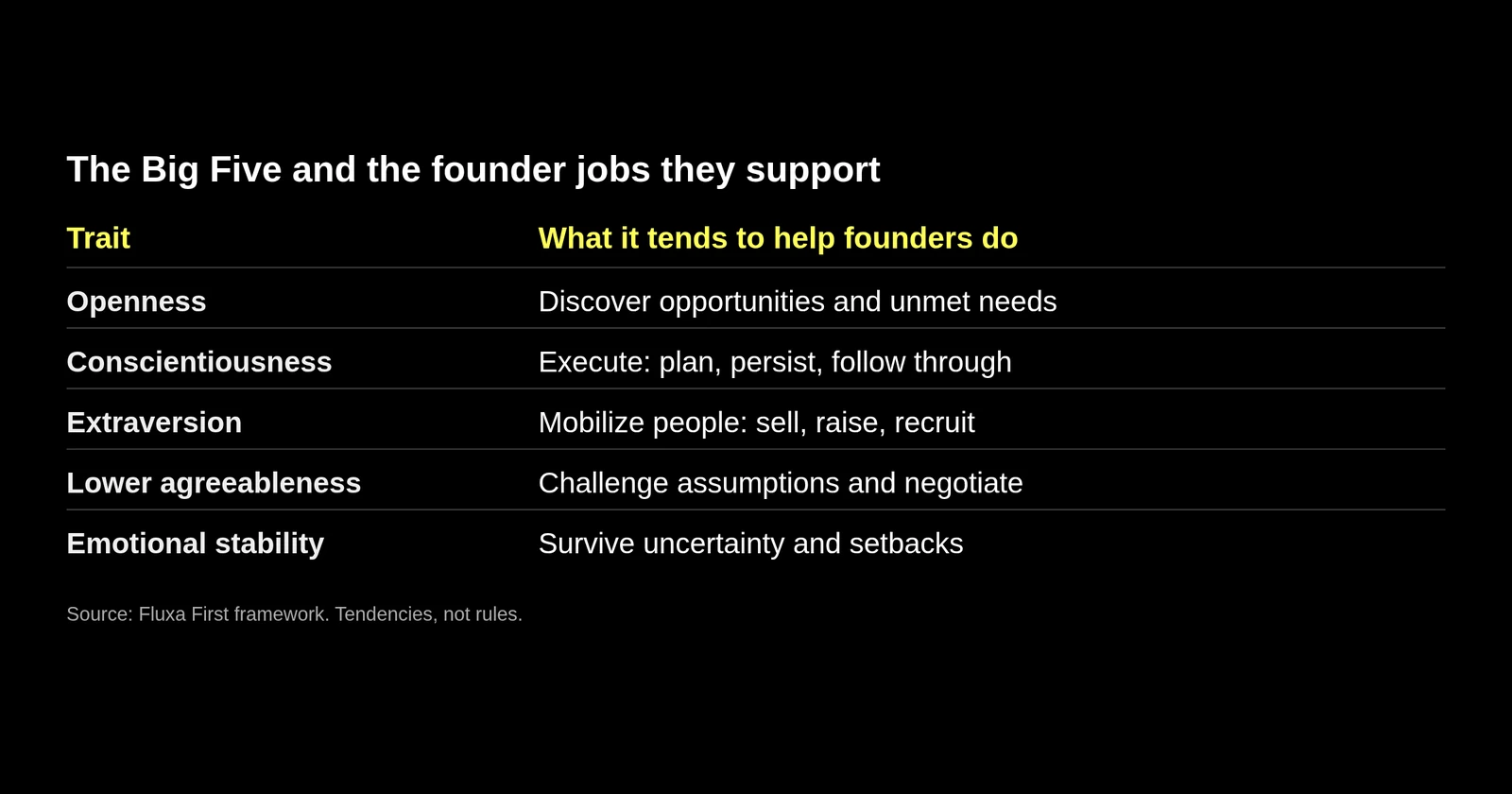
- Each trait tends to help founders with a different job, from spotting opportunities to executing, selling, negotiating and absorbing setbacks. No single founder is strong at all of them.
- Good founding teams are complementary, not opposite. Moderate differences make easier collaborators than extreme ones, and a team that is too agreeable can hide the dissent it needs.
Co-founder fit is one of the biggest risks in any new company, and one of the least examined. Most teams form by accident: friends, former colleagues, whoever was in the room. In our studio we form teams on purpose, and one of the tools we use is the Big Five personality model. The point is not to label anyone. It is to make sure the team covers the jobs a young company needs done, and to see friction coming before it costs a quarter.
What is the Big Five, and why use it?
The Big Five, or Five Factor Model, describes personality along five spectra: openness, conscientiousness, extraversion, agreeableness and neuroticism. Instead of sorting people into a handful of types, it places each person somewhere on each spectrum, like a fingerprint.
We prefer it to popular type systems for a few reasons. The traits were found statistically, by looking at how self-reported characteristics cluster across large populations. Trait models are generally considered more predictive than typologies. And scores are percentiles along a normal curve, so there are no good or bad results, only defaults that help in some situations and hurt in others.
What does each trait help a founder do?
Here is how we think about each trait in the context of starting a company. These are tendencies, not rules.
- Openness helps founders discover opportunities. It is linked to creativity, curiosity and spotting unmet needs, and meta-analyses of entrepreneurs list it, along with conscientiousness, among the traits most associated with becoming an entrepreneur.
- Conscientiousness helps founders execute. It shows up as discipline, planning, persistence and customer follow-through, and matters most as a company scales.
- Extraversion helps founders mobilize people and resources. Assertiveness in particular helps with sales, fundraising and recruiting.
- Lower agreeableness can help founders challenge assumptions and negotiate. Being willing to disagree, push back and make hard personnel calls is useful, in moderation.
- Emotional stability helps founders survive setbacks. Lower neuroticism makes it easier to make decisions under uncertainty and absorb repeated failures without burning out.
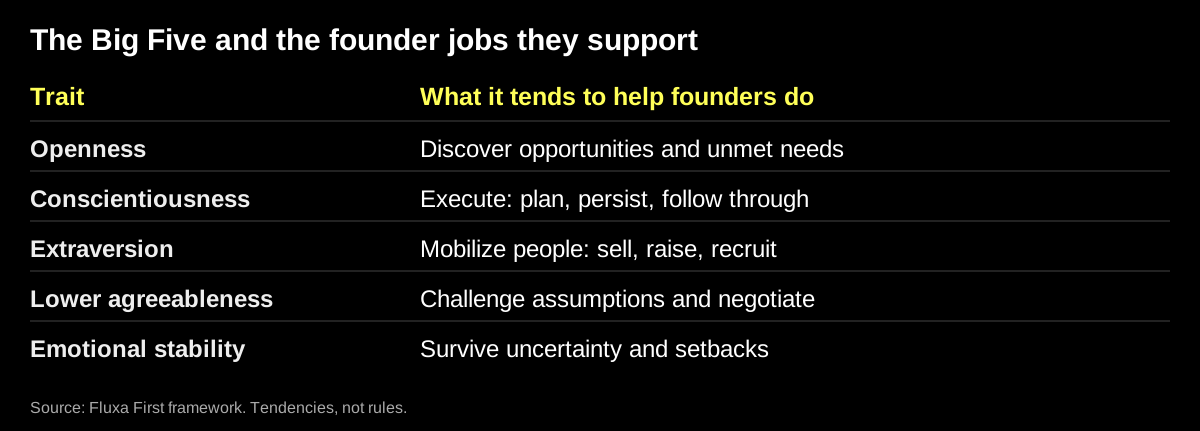
Nobody is at the useful end of all five. A founder who is highly open may struggle with the orderly follow-through that a hardware build demands. A highly conscientious operator may be slow to see a pivot. That is why we think about the team, not the individual.
How do we use it to form teams?
When we form a founding team around a problem space, we look for coverage. Who will find the next opportunity? Who will make sure the prototype ships on schedule? Who will sell to the first customer and recruit the first engineers? Who will stay steady when a test fails?
We also watch the group dynamics:
- Complementary is not the same as opposite. People who differ moderately on a trait usually collaborate well. People at opposite extremes often struggle to understand each other at all.
- Similar people can still clash. Two founders who are both highly assertive, for example, may compete for the same role.
- Outliers are harder to override. Someone at the far end of a spectrum will find it harder to act against type when the situation demands it.
- Personas can hide personality. People often present a professional version of themselves, so we look at behavior over time, not just first impressions.
- Too much agreeableness hides dissent. A team where nobody pushes back feels pleasant and makes worse decisions. We would rather see healthy disagreement early.
Can founders work around their own defaults?
Yes, and this is the most useful part. Traits are fairly stable through adulthood, and research suggests they are substantially heritable. But they describe defaults, not limits. Once founders know their own tendencies, they can consciously override them when needed: the introvert who schedules customer calls anyway, the visionary who builds a checklist for the test campaign. Like any muscle, the override gets stronger with use.
That self-knowledge also makes founders better at the rest of company building. Knowing how you differ from your co-founder makes it easier to split roles, settle disagreements and explain the team to investors.
What this means for founders and investors
For founders choosing a co-founder, ask what jobs the company needs in its first two years and who will do each one. Then ask how the two of you will disagree. If the answer is that you never do, that is a warning, not a comfort.
For investors, the team slide usually lists credentials. We look for coverage and for evidence that the team has worked through conflict. A complementary team that knows its own blind spots is one of the best signals we look for that a company can get through the hard middle years. It pairs well with how we map the buying table before the first sale: understanding people is a founder skill, inside the company and out.
Frequently asked questions
What is the Big Five personality model?
It is a trait model that describes personality along five spectra, often abbreviated OCEAN, openness, conscientiousness, extraversion, agreeableness and neuroticism. Scores are percentiles, not grades. The traits were identified by statistical analysis of how self-reported characteristics cluster across large populations, and researchers generally find trait models more predictive than popular type systems.
Should a founding team have opposite personalities?
Not opposite, complementary. Teams work best when members cover different strengths but are close enough to understand each other. Large differences on a trait can make collaboration hard, while some similar personalities can still clash. The goal is coverage of the work the company needs, with enough overlap to communicate.
Can founders change their personality traits?
Traits are fairly stable through adulthood, but behavior is not fixed. Knowing your defaults lets you consciously override them when a situation calls for it, and that override gets easier with practice. That self-knowledge is the main reason we have founders look at their own profiles.