
When buyers finance the mine: Micron, Indium and the new supply chain playbook
Key takeaways
- On October 20, 2026, Micron said it will fund Indium Corporation to expand refining and manufacturing in Rome, New York, restarting domestic processing of critical minerals used in chipmaking, paired with a long-term supply agreement.
- On October 13, trader Traxys signed a 15-year take-or-pay offtake for half of NioCorp’s planned ferroniobium output from its Nebraska project, and took marketing rights for its other planned products, subject to NioCorp securing project financing.
- Big buyers are no longer waiting for markets or governments to secure their inputs. Funding and committed offtake are what turn a domestic refinery from a plan into a financeable project.
America’s critical minerals problem is less about rocks in the ground than about refining, and refining capacity needs buyers before it needs permits. In October, two deals showed who is stepping up to be those buyers. A chipmaker is funding a domestic supplier to restart processing, and a metals trader signed a take-or-pay contract for a Nebraska mine. We think buyer-financed supply is becoming one of the most important tools for rebuilding the industrial base.
What did Micron and Indium announce?
On October 20, Micron announced strategic funding that will let Indium Corporation expand its refining and manufacturing operations in Rome, New York, restarting domestic processing of critical minerals essential to advanced semiconductor manufacturing. The two companies will sign a long-term supply agreement giving Micron access to the high-purity output.
The investment is part of Micron’s plan, announced in July, to invest up to $3 billion in strengthening the US semiconductor supply chain. Micron said the deal should reduce reliance on concentrated global refining capacity. Indium Corporation, based in Central New York for more than 90 years, works with materials including indium, gallium, germanium and tin. The release does not say which specific minerals the restarted processing will cover or how much Micron is investing.
What did NioCorp and Traxys sign?
On October 13, NioCorp’s Elk Creek subsidiary signed an offtake agreement with Traxys North America. Traxys will buy, on a take-or-pay basis, 50% of the project’s annual ferroniobium production, or 3,700 metric tons a year at its election, for 15 years from commercial production. Traxys also gets the exclusive right, but not the obligation, to market and sell the project’s other planned products, including scandium, titanium tetrachloride and several rare earth oxides. Pricing references published market prices, less discounts or commissions. The agreement is binding, but deliveries depend on NioCorp completing project financing and construction, and either side can end it if the US Export-Import Bank has not approved senior debt financing, or financial close has not occurred, by the end of 2027 (with a possible six-month extension).
Traxys describes itself as playing a central role in the federal Project Vault initiative to supply critical minerals to large manufacturers, according to its own announcement.
Why are buyers financing supply?
A new refinery or mine faces a hard financing problem. Its output competes with incumbents abroad that have scale and, at times, state support and low prices. Lenders want to know the product will be sold at a price that covers debt. Without that, even a technically sound project struggles to raise money.
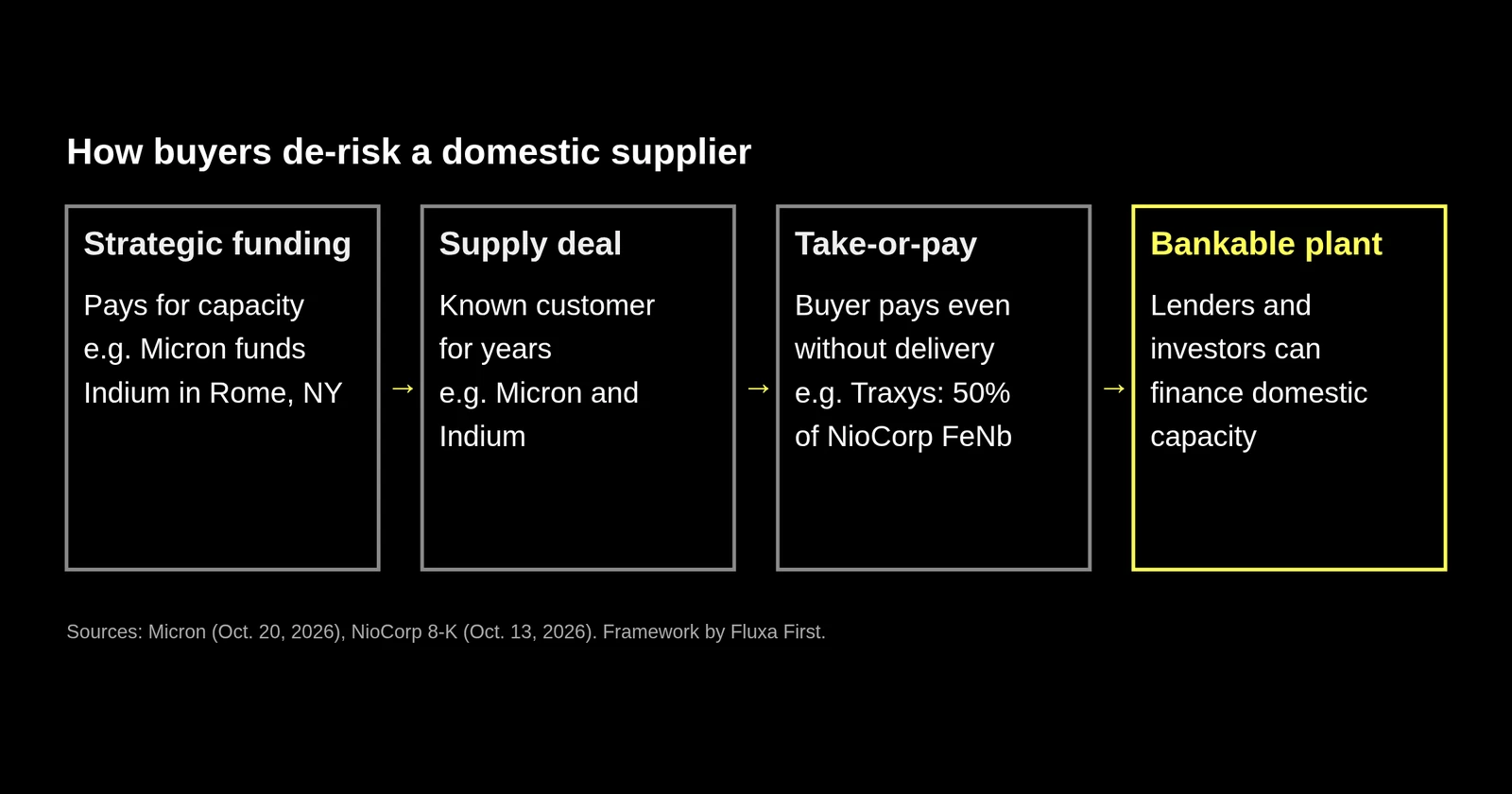
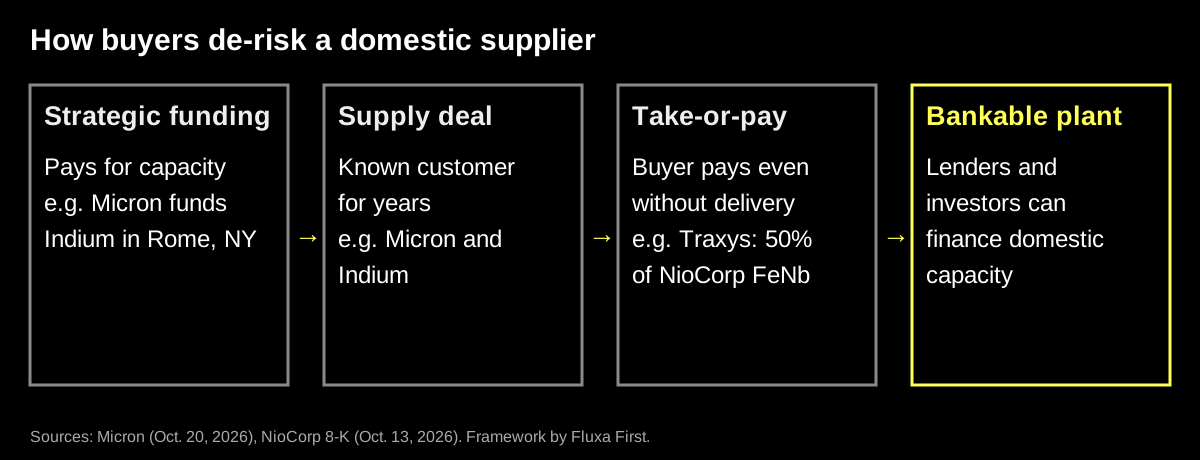
Buyers can solve that problem in three ways, and these deals use all of them:
- Strategic funding pays for capacity directly, as Micron is doing for Indium.
- Long-term supply agreements give the supplier a known customer for years.
- Take-or-pay offtake commits the buyer to pay for output whether or not it takes delivery, which is the strongest signal a lender can get.
For the buyer, the logic is risk management. A chipmaker that depends on a few overseas refiners for a high-purity input is exposed to export controls, shipping shocks and price spikes. Paying to secure a domestic source, in the same state as its planned fabs, is insurance against all three. We see the same pattern across the industrial base, from power transformers to castings and forgings.
What does this mean for founders?
For hard-tech founders building upstream, in refining, materials, components or processing, the message is encouraging and demanding.
- Your first investor may be your customer. Large buyers with supply risk will fund capacity, sign long-term contracts or prepay. Pitch them as partners, not just customers.
- Bankability beats technology alone. A process that works in the lab becomes a company when a buyer commits to the output. Design pilot programs that end in a contract.
- Watch the terms. Offtake and strategic funding can come with exclusivity, pricing discounts or marketing rights that limit future options. Negotiate them with the same care as an equity round.
- Location is part of the pitch. Being in the same region as a buyer, as Indium is to Micron’s planned New York fabs, can shorten supply chains and strengthen the case.
How we see it
We believe American sovereignty in critical materials will be rebuilt one bankable project at a time, and that the companies that need these materials will provide much of the financing. Government programs help, but buyer commitments are what turn a refinery plan into steel and concrete. For founders, the most valuable thing to build alongside the process is the customer relationship that pays for it.
Company statements are forward-looking and as reported in the linked sources. This post is general commentary, not investment advice.
Frequently asked questions
What is a take-or-pay offtake agreement?
It is a contract in which a buyer commits to purchase a set share or volume of a project’s output, and pays even if it does not take delivery. For a new mine or refinery, that commitment gives lenders and investors confidence that the product will be sold, which makes the project much easier to finance.
Why are companies funding their own suppliers?
Because the inputs they depend on, especially refined critical minerals, are often processed in only a few places, many of them abroad. Funding a domestic supplier and signing a long-term supply deal secures the input, shortens the supply chain and reduces the risk of export controls or price shocks disrupting production.