
Venture capital is concentrating in the Bay Area. Hard tech is built everywhere else.
Key takeaways
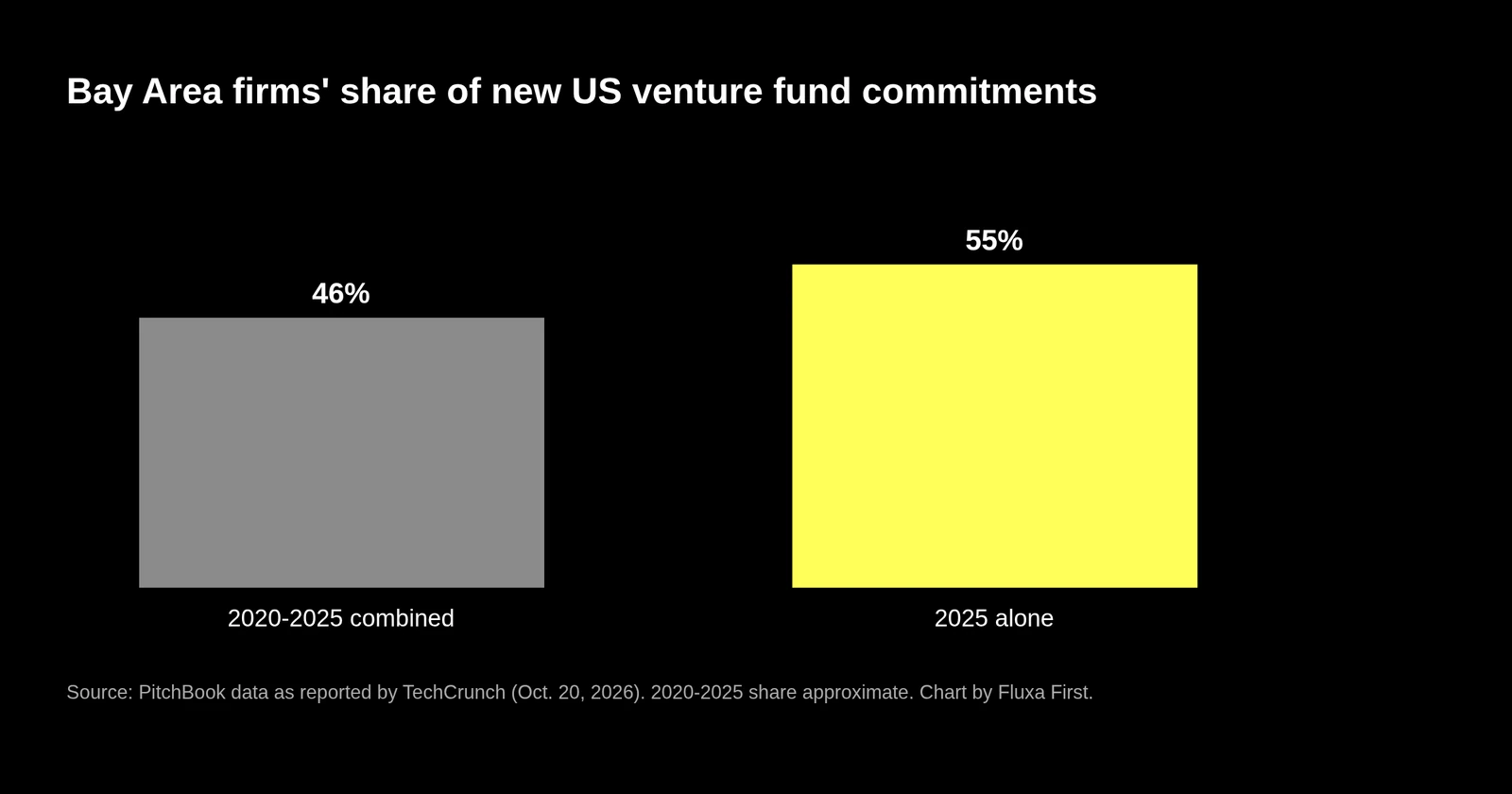
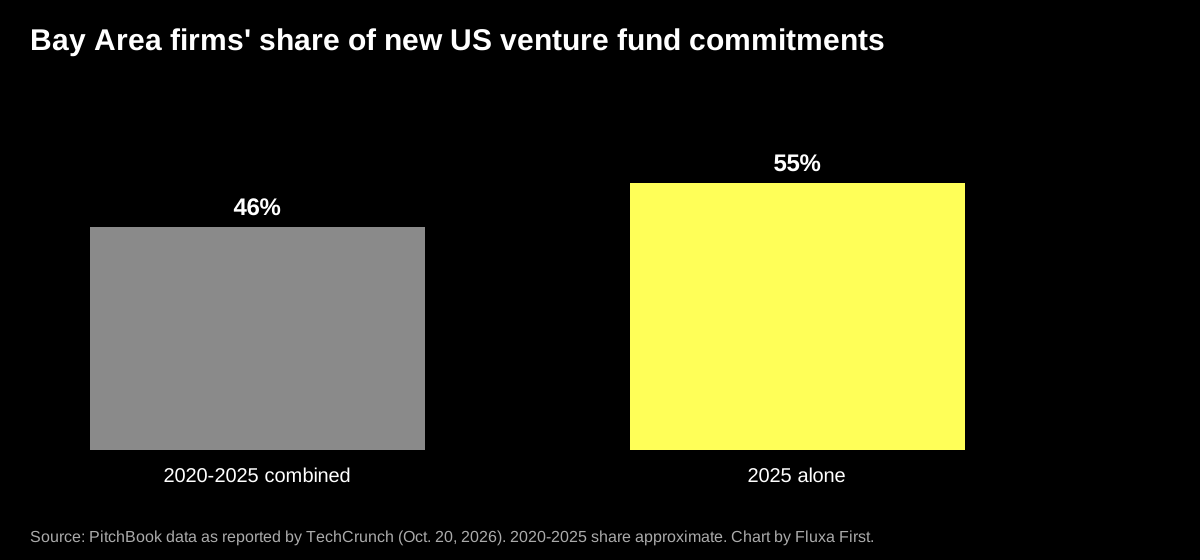
- Bay Area venture firms raised $352 billion from 2020 through 2025, roughly 46% of all US venture fund commitments, and their share rose to 55% in 2025, according to PitchBook data reported by TechCrunch.
- Funds outside the Bay Area are still closing, such as Inspired Capital’s $450 million Fund IV in New York and Inovia’s $200 million first close in Canada, but the overall pool is concentrating.
- Hard-tech companies are built near ranges, ports, plants, test sites and government customers, so founders in those places should plan for capital that travels to them, and for investors who know their industries.
More of America’s venture capital is pooling in one region. Bay Area firms took about 55% of new US venture fund commitments in 2025, compared with roughly 46% across 2020 through 2025 combined, according to PitchBook data reported by TechCrunch. We think this matters most for hard tech, because the companies that build rockets, ships, reactors and factories are rarely built in the Bay Area.
How concentrated is venture fundraising?
Between 2020 and the end of 2025, Bay Area firms raised $352 billion for venture funds, about 46% of the US total, per the same PitchBook figures. Last year, the share jumped to 55%. Meanwhile, Private Equity International reported in mid-October that global venture fundraising was on pace for upward of $94 billion this year: better than 2025’s $89.2 billion, but well below the $223.5 billion peak in 2022.
So the global pool is smaller than it was, and in the US a bigger share of it sits with firms in one region.
Funds outside the Bay Area are still closing. New York’s Inspired Capital closed a $450 million fourth fund in October, after a $330 million third fund in early 2024, and told TechCrunch it backs about 10 companies a year with checks of $1 million to $15 million. In Canada, Inovia held a $200 million first close on its sixth early-stage fund, backed by Canadian institutions. Those are healthy signs, but they are exceptions in size.
Why does geography matter for hard tech?
Software founders can build almost anywhere and fly to Sand Hill Road. Hard-tech founders depend on physical assets that are spread across the country:
- Test and launch infrastructure, such as ranges, test stands and spaceports.
- Industrial capacity, such as shipyards, foundries, machine shops and qualified suppliers.
- Customers, such as military bases, utilities, ports and plants.
- Skilled people, including technicians, welders and engineers who live near those assets.
That is why so many strong hard-tech teams form near Florida’s Space Coast, Gulf Coast yards, Midwest plants or national labs. The talent and the problems are there. When most decision-makers sit far away, the distance shows up in diligence. Investors who do not know a sector, or have never stood on a factory floor, tend to ask for more proof, move slower, or pass.
What should founders and investors do about it?
For founders building outside the main venture hubs:
- Pitch to sector knowledge, not just geography. An investor who understands maritime or energy will see your evidence faster than a generalist down the street. Map who has backed companies like yours.
- Use local capital first. Regional funds, angels, economic development programs and non-dilutive grants can fund the milestones that make distant investors comfortable. We think of this as working down the capital stack, using the cheapest capital first.
- Show evidence, not just vision. A working prototype, a test result or a signed pilot travels well. It turns a long-distance pitch into a short conversation.
- Build relationships early. Distant investors commit faster to founders they have watched hit milestones over time.
For limited partners and investors, concentration is also an opportunity. When most capital competes for the same deals in the same places, valuations there rise. Capital that goes where hard tech is actually built faces less competition and often finds founders who are capital-efficient by necessity. We have written about how LPs are rethinking distributions and emerging managers, and geography is part of that picture.
How we see it
Fluxa First is a venture studio built on the idea that American hard tech needs capital and builders close to where the work happens. We build companies alongside founders and back them with studio-aligned resources, and we do it near the infrastructure and customers those companies need.
We do not expect the concentration of venture dollars to reverse soon. That makes it more important for founders outside the big hubs to plan for it: raise in stages, lean on people who know the industry, and let evidence close the distance. We expect many durable companies to come from places most of the market is ignoring.
Figures are as reported in the linked sources. This post is general analysis, not investment advice.
Frequently asked questions
What does venture capital concentration mean for founders?
When more fund commitments flow to firms in one region, more of the decision-makers sit there too. Founders elsewhere may need to travel more, lean on regional and sector specialists, or show more evidence before a distant investor commits. It does not mean capital is unavailable, but it changes who you pitch and how.
Why does hard tech get built outside Silicon Valley?
Hard-tech companies need physical things software startups do not: launch sites, test ranges, shipyards, factories, power, skilled trades and nearby customers such as military bases or utilities. Those assets are spread across the country, so many of the best hard-tech teams form near them.