
Retail and 401(k) money is coming to private markets. Venture should get ready
Key takeaways
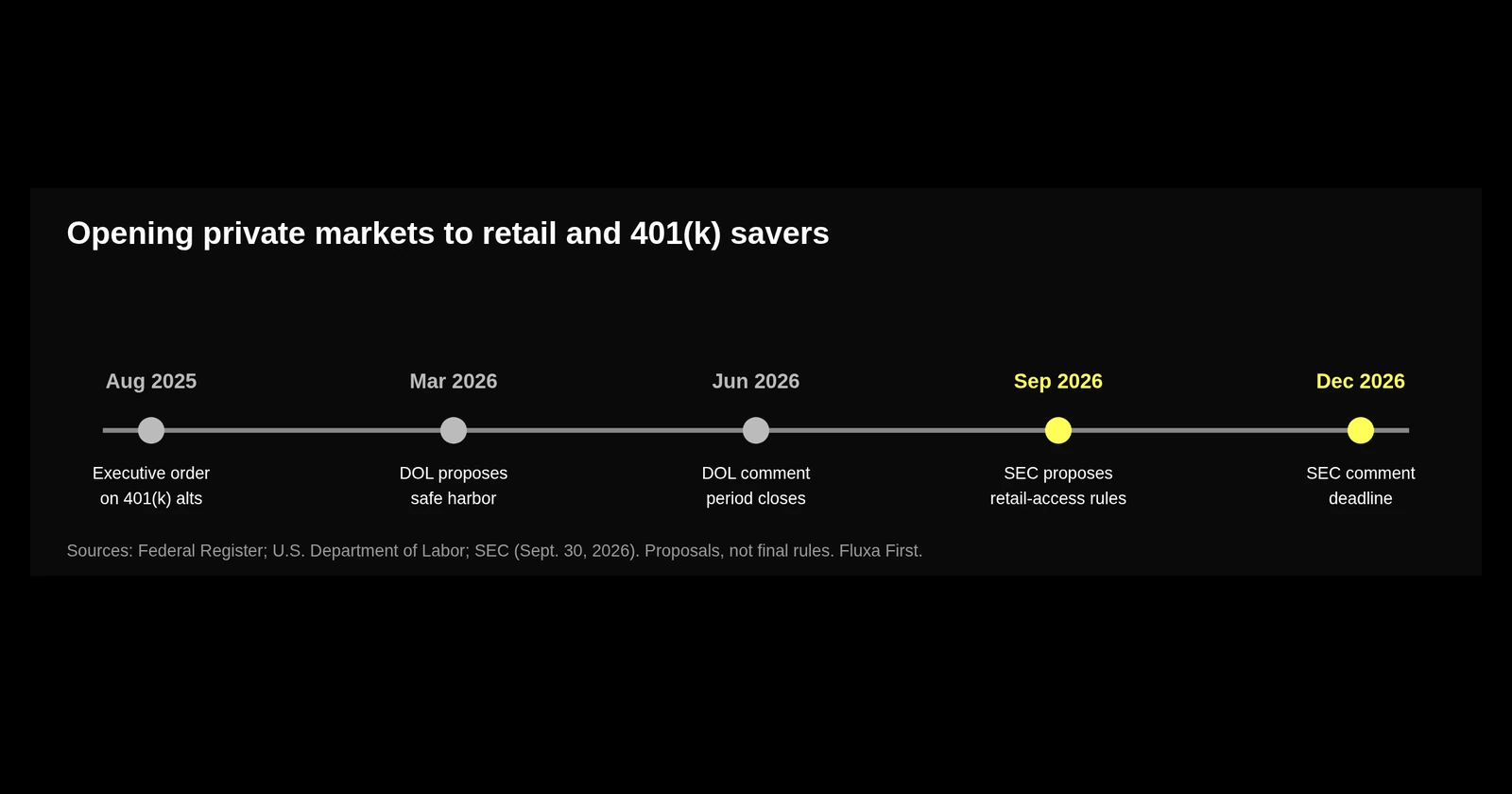
- The Labor Department proposed a safe harbor in March 2026 for 401(k) fiduciaries that consider alternatives, including private markets; the comment period closed June 1 and the rule is still a proposal.
- On Sept. 30, 2026, the SEC proposed rules to widen retail access to private-market strategies, including interval fund changes, with comments due Dec. 4.
- Money from savers comes with demands for liquidity, regular valuation and reasonable fees, which favors assets that produce cash and can be marked honestly.
- Venture managers and founders whose model returns cash during the holding period are best placed to use this new capital.
Washington is steadily opening private markets to ordinary savers, and venture capital should take that seriously. The new money will be large, but it will also be demanding. It will want liquidity, honest valuations and cash coming back. We think that favors a different kind of venture than the one built around a handful of enormous outcomes.
What changed for 401(k) plans?
In August 2025, an executive order directed the Labor Department to clarify how 401(k) fiduciaries may offer funds that include alternative assets, a category that covers private equity, private credit, venture and more. On March 30, 2026, the department proposed a rule that would create process-based safe harbors for fiduciaries choosing plan investments. Under the proposal, a fiduciary that carefully weighs performance, fees, liquidity, valuation, benchmarks and complexity would get strong deference for its decision.
The department said the change could widen options for more than 90 million Americans. It also noted that, while plan managers have always had authority to consider alternatives, almost none have done so. Comments closed on June 1. As of this writing, the Federal Register shows the proposal but no final rule.
What is the SEC doing?
On September 30, the SEC voted to propose a package aimed at widening retail access to private-market strategies. It would:
- let registered advisers receive performance-based pay from more client types, including regulated funds;
- modernize interval funds, including scheduling repurchases to better match a portfolio’s liquidity;
- replace case-by-case exemptions with a rule letting closed-end funds offer multiple share classes.
The SEC also asked for comment on new ways for individuals to qualify as accredited investors, such as passing a FINRA-developed exam or holding credentials like the CPA license or CFA charter. The interval fund proposal was published in the Federal Register on October 5, with comments due December 4.
Markets are moving ahead of the rules. PitchBook’s Q1 2026 secondary market note pointed to the launch of two NYSE-listed venture funds with no accreditation requirement, and estimated the annualized US venture secondary market at $112.2 billion, larger than public listings.
What will this capital demand?
Money in 401(k) accounts is not patient in the way an endowment is. It sits in products that have to price shares regularly, honor redemptions and justify fees to fiduciaries who can be sued. Look at the factors the Labor Department listed: liquidity and valuation sit right next to performance and fees.
That has consequences.
Liquidity matters more. An interval fund that promises periodic repurchases needs cash coming in from its holdings, not only from new investors. Assets that throw off distributions are easier to hold than assets that pay nothing for ten years.
Valuation has to be defensible. Marking a pre-revenue company at its last round price is easy in a private fund and much harder in a product sold to savers. Companies with revenue and real comparables are simpler to value.
Fees get scrutiny. Retail products will be compared with cheap index funds. Managers will need to show net returns that justify the cost.
| What retail products need | What fits well | What fits poorly |
|---|---|---|
| Regular liquidity | Assets with cash yield or distributions | Ten-year lockups with no interim cash |
| Defensible marks | Revenue-generating companies | Pre-revenue paper markups |
| Justifiable fees | Steady net returns | Returns that depend on one outlier |
What does this mean for venture managers and founders?
For managers, it raises the value of a track record of realized cash, not paper gains. The firms that can show distributions, and can explain how they will produce more, will be the ones that platform builders and plan fiduciaries choose. We made a related point about LPs in why LPs keep re-upping with incumbents: cash returned is the currency of trust.
For founders, it means a wider range of investors over time, including registered funds that care about steady value and liquidity. A hard-tech company with contracted revenue, positive unit economics and a credible path to cash flow will look more attractive to these buyers than one whose only story is a giant exit.
There are real risks too. Ordinary savers can be hurt by high fees, opaque valuations and products that promise more liquidity than their assets can support. Good rules and good disclosure matter. Growth in access should not mean lower standards.
How we see it at Fluxa First
We build durable companies in aerospace, maritime, autonomy, energy and advanced manufacturing alongside founders, and we back them with studio-aligned resources. Many hard-tech businesses can earn revenue well before an exit, and we think capital structures that reflect that will matter more as private markets open to new kinds of investors.
We think that structure is a better match for where private-market capital is heading. When savers become LPs, even indirectly, the asset class has to behave more like an investment and less like a lottery. Companies that make money, and investment structures that pass some of it back along the way, will be ready for that shift.
This post is general commentary, not investment, legal or tax advice. Rule descriptions reflect proposals as of their publication dates and may change.
Frequently asked questions
Can 401(k) plans invest in venture capital today?
Plan fiduciaries have always had legal room to consider alternative assets, but very few have done so because of litigation risk. A 2025 executive order directed the Labor Department to clarify the rules, and its March 2026 proposal would give fiduciaries a process-based safe harbor. As of late October 2026 the rule has not been finalized, so access remains limited and mostly indirect, through registered funds.
What is an interval fund?
An interval fund is a registered closed-end fund that offers to buy back a portion of its shares from investors at set intervals, rather than daily. That structure lets it hold less liquid assets such as private companies or private credit. The SEC’s September 2026 proposal would modernize these rules, including allowing repurchase schedules that better match a portfolio’s liquidity.