
Continuation vehicles are now a mainstream exit. What LPs and founders should know
Key takeaways
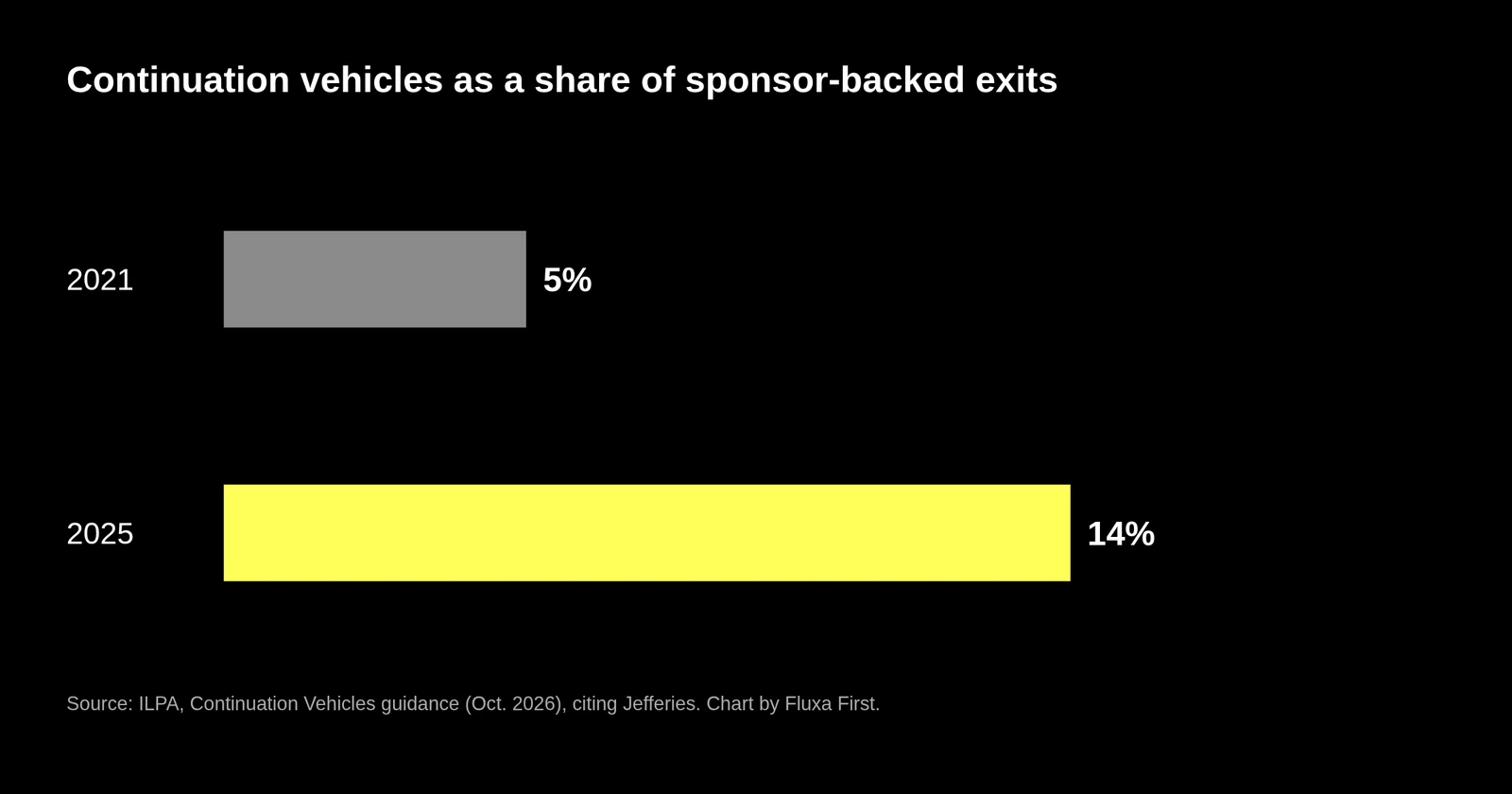
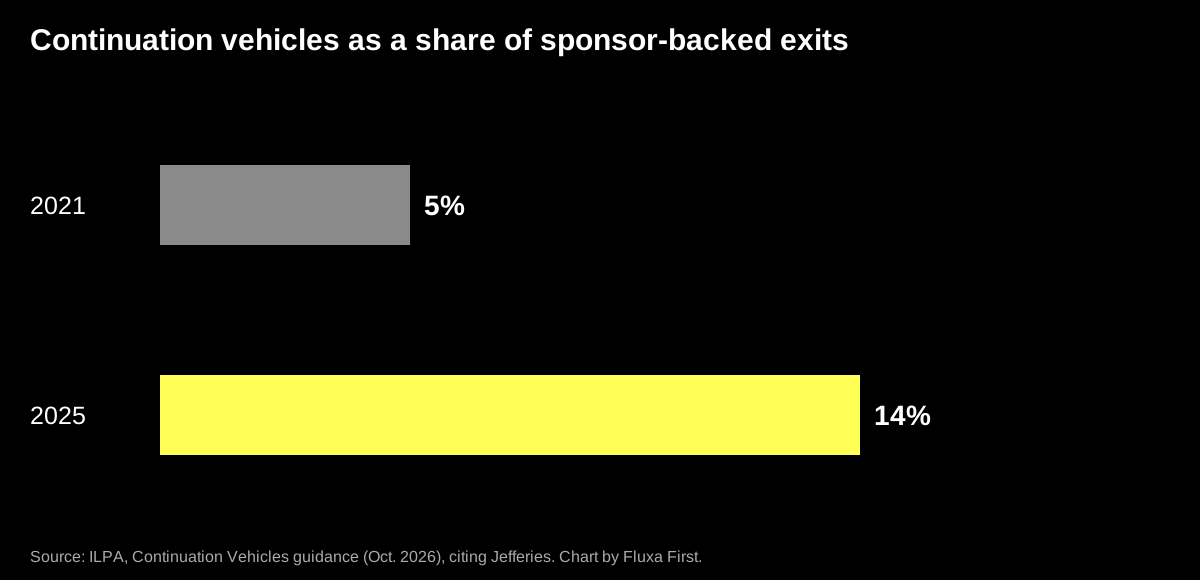
- Continuation vehicles made up roughly 14% of sponsor-backed exits globally in 2025, up from 5% in 2021, according to ILPA citing Jefferies.
- ILPA’s final guidance, issued in October 2026, asks for at least 20 clear business days to decide, independent pricing, and treating LPs who do not respond as sellers.
- Most LPs still sell rather than roll, often because of time, mandate and liquidity limits rather than the quality of the asset.
- We think liquidity should be earned by companies that generate cash and reach real exits, not engineered at the end of a fund’s life.
Continuation vehicles have moved from a niche workaround to a standard way private funds return cash. In October 2026 the Institutional Limited Partners Association (ILPA) published final guidance on how these deals should be run. For anyone who invests in or raises from private funds, including hard-tech founders, the message is simple: when exits are slow, liquidity gets engineered, and the terms of that engineering matter.
What is a continuation vehicle, and why is it growing?
A continuation vehicle, or CV, is a new fund managed by the same general partner that buys one or more companies from an older fund. Existing limited partners (LPs) choose to sell for cash or roll into the new vehicle. Secondary buyers usually supply the money.
ILPA’s guidance, Continuation Vehicles: Advancing Alignment Through Best Practices, puts the scale plainly. Citing Jefferies data, it says CVs represented roughly 14% of sponsor-backed exits globally in 2025, up from 5% in 2021. ILPA links that growth to a prolonged weak exit environment, in which managers transfer assets to vehicles they still control instead of selling them or listing them.
The broader secondary market tells the same story. PitchBook reported record secondary volume of $121 billion in the first half of 2026, with $65 billion in GP-led deals and $56 billion in LP-led deals.
Why do so few LPs roll?
CVs are pitched as a way to keep owning a manager’s best companies. Yet most existing LPs take the cash. PitchBook cites two measures: Jefferies data showing average LP rollover rising from 11% in 2023 to 15% in 2025, and a National Bureau of Economic Research working paper finding the share of LPs rolling fell from about 14% to 15% in 2018 and 2019 to below 5% by 2025. The methods differ, but both say most LPs sell.
The reasons are often structural, not a judgment on the asset. Decision windows are short, investment committees may not meet in time, many mandates, especially at public pensions, do not allow continuation vehicle investing, and the same NBER data shows public pensions rolled only about 2% in 2024. After years of thin distributions, many LPs simply need the cash. And the manager sits on both sides of the trade, setting price, information and timing.
What does ILPA’s final guidance ask for?
According to a Fried Frank summary published October 23, the final guidance updates ILPA’s 2023 framework and the draft ILPA released in June 2026. It is non-binding, but it is more specific on the points LPs fight over most.
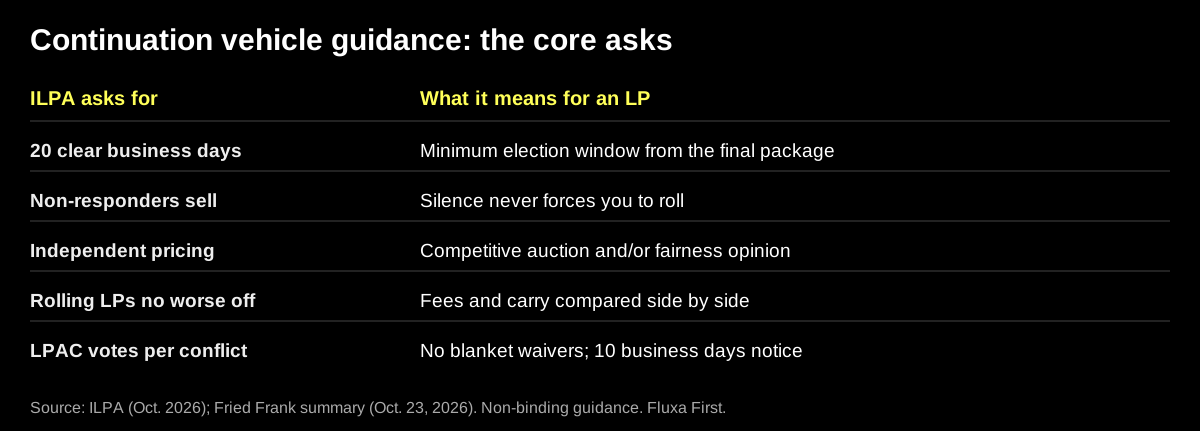
- Time to decide. Elections should run at least 20 clear business days from the final election package, longer for complex deals, with data room access throughout.
- Silence means sell. LPs who do not respond should be treated as sellers, never forced to roll.
- Defensible pricing. Price should be supported by a competitive auction or independent validation, often a fairness opinion, and any discount to prior marks should be explained.
- Rolling LPs protected. Fees and carry for rolling LPs should generally be no worse than if the asset had stayed in the original fund, with side-by-side comparisons.
- Real oversight. The LP advisory committee should get at least 10 business days of notice and vote on each conflict rather than grant blanket waivers.
The biggest change from the July draft is that the option to let LPs simply stay in the old fund on existing terms is no longer a default. It is now one choice among several, used only where it fits the deal.
Why should venture investors and founders care?
Continuation vehicles have so far been mainly a private equity tool. But the tool is open to any manager with assets that outlive their fund, and hard-tech portfolios are natural candidates. Companies in aerospace, energy or advanced manufacturing often need longer than a 10-year fund allows to reach a sale or listing.
For a founder, a CV can be good news: a new investor, more time and sometimes fresh capital. It also changes who owns your cap table and on what clock. If your lead investor proposes moving your company into a CV, ask who the new money is, what the new hold period is, whether follow-on capital is committed, and how the price was set. Those answers shape your next three to five years.
How we see it
We think CVs are a symptom. They exist because too many venture portfolios were built for a narrow set of large exits, and when those exits stall, liquidity has to be manufactured. ILPA’s guidance makes that process fairer, which is good. It does not fix the underlying problem.
Our view is that liquidity should be earned. Durable companies generate revenue and cash early, and capital should match how long hard tech actually takes, so a company’s timeline is not forced to fit a fund’s. For LPs, that means asking managers not only about marks but about how cash will come back: from operating businesses, strategic sales and realistic exits. We have made a related case about LP distributions and emerging managers and the IPO window for hard-tech exits.
A continuation vehicle can be a sensible tool. It should not be the plan.
This article is general information, not investment, legal or tax advice.
Frequently asked questions
What is a continuation vehicle?
A continuation vehicle is a new fund, run by the same manager, that buys one or more companies from an older fund. Existing investors can sell for cash or roll their stake into the new vehicle, and new secondary investors usually supply the purchase capital. It lets a manager keep owning an asset beyond the original fund’s life.
Is ILPA's continuation vehicle guidance binding?
No. ILPA describes it as principles-based and non-binding. It sets expectations for process, pricing, disclosure and LP treatment, and law firm commentary expects LPs and advisory committees to measure deals against it.
Why do most LPs sell instead of rolling?
Reasons include short decision windows, investment mandates that, at many public pensions, do not cover continuation vehicles, a need for cash after years of slow distributions, and concerns about conflicts when the manager sits on both sides of the trade.