
Designing out rare earths: the quiet supply chain strategy
Key takeaways
- TSMC has asked equipment suppliers whether motors in its factory automation could avoid rare earths, Reuters reported on October 22, 2026, citing three people familiar, to cut its exposure to China’s export controls. The talks are at an early stage.
- In October, Moog and Niron said they would exhibit rare-earth-free iron nitride magnet actuator work for Army systems, Proterial and FEV described a simulated motor concept without heavy rare earths, and Ferrstron road-tested a 150 kW ferrite-magnet motor.
- Reshoring rare earth mining and magnet making takes years. Designing products that need fewer or no rare earths is a parallel strategy that can work faster, and it is a real opportunity for hard-tech founders.
The usual answer to China’s grip on rare earths is to mine, refine and make magnets somewhere else. That work matters, but it takes years. A second answer is getting louder: design products that need fewer rare earths, or none at all. In October, from chip fabs to Army actuators to truck motors, companies showed how far that strategy has come. We think it deserves as much attention as new mines.
What is TSMC doing about rare earths?
TSMC, the world’s largest contract chipmaker, has asked suppliers whether the motors in its factory automation equipment could be replaced with designs that use no rare earths, according to an exclusive Reuters report on October 22 that cited three people familiar with the matter (republished by The Japan Times). TSMC declined to comment. The discussions are early and have not led to large-scale adoption.
The reason is simple. Rare earth magnets sit inside the motors that move parts in industrial equipment. If supplies were cut, chip production could be disrupted. China put some rare earth materials, magnets and related processing technology under export licensing last year. Even the most advanced manufacturer in the world is now checking the motors inside its tools.
What rare-earth-free options are emerging?
Several October announcements show the range of approaches.
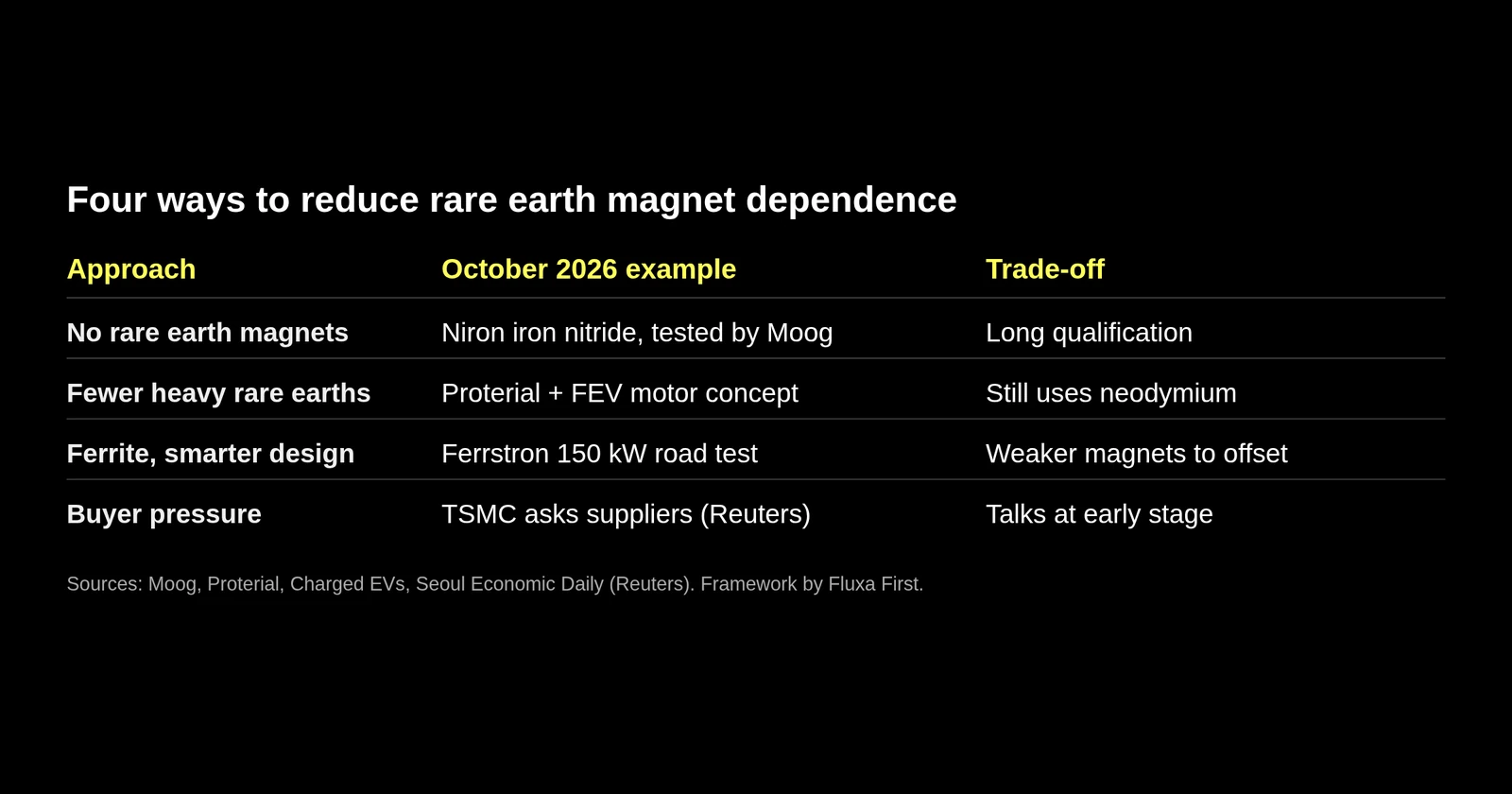
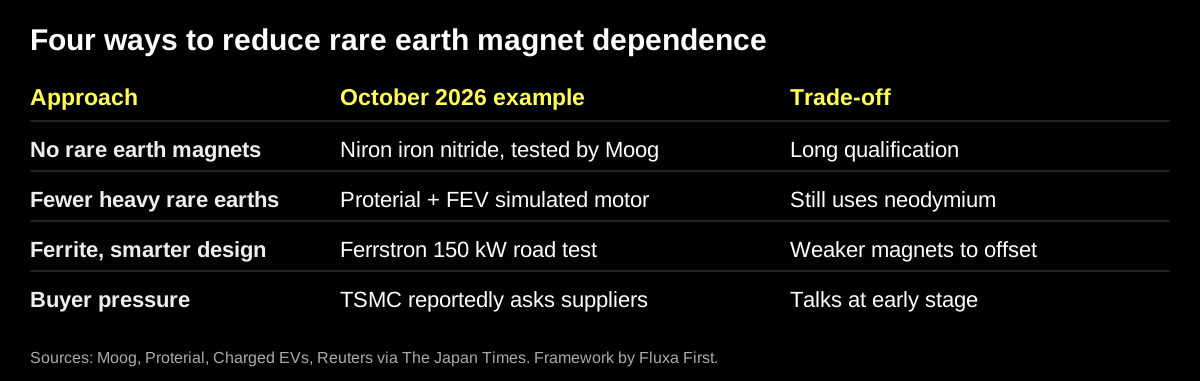
- No rare earth magnets at all. Moog and Niron Magnetics said they would exhibit joint work on actuators built on Niron’s iron nitride permanent magnets at the Association of the United States Army annual meeting, October 12 to 14. Moog is testing and qualifying the magnets in electromechanical actuators for land vehicles and guided munitions. Niron says it has been producing magnets and running customer qualification since 2025.
- Fewer heavy rare earths. Proterial and FEV described a simulated traction motor concept that pairs amorphous alloy cores with neodymium magnets free of heavy rare earths, evaluated in simulation against a 230 kW reference passenger-car drive unit, with results suggesting up to 300 kW output and 27% less weight. That is a company simulation, not a built motor.
- Weaker magnets, smarter design. Ferrstron road-tested a 150 kW motor that uses abundant ferrite magnets in a 2.3-ton vehicle. Ferrite is weaker than rare earth magnets and more prone to demagnetization, so the company compensates with its axial-flux architecture, cooling and control algorithms. It says the test puts the technology at TRL 6.
- Buyer pressure. TSMC’s supplier inquiry is the demand-side version: a large customer asking its supply base to change the design.
Why does substitution matter geopolitically?
Supply chain policy tends to focus on supply: new mines, refineries, magnet plants, stockpiles and price floors. We covered those in our post on rare earth export controls and allied price floors for critical minerals. They are necessary, but they take a long time and they compete against an incumbent with scale and low prices.
Substitution changes the equation from the demand side. Every motor that no longer needs a rare earth magnet reduces the leverage any single supplier has. It also makes the new mines and refineries less vulnerable to price dumping, because the market they serve is less captive. And it spreads the work across allies: materials companies, magnet makers and motor startups in several countries are attacking the same problem from different angles.
Substitution is not free. Rare-earth-free designs often give up some power density, add size or weight, or require new manufacturing processes and long qualification. In defense and aerospace, qualification alone can take years. That is why both strategies are needed: more secure supply for applications that truly need rare earths, and new designs for those that do not.
What should founders and investors take from this?
- Substitution is a market, not a footnote. New magnet materials, motor architectures, control software and test services all have customers who are actively asking for alternatives.
- Qualification is the moat. The company that gets its magnet or motor qualified in a defense actuator or a fab tool first will be hard to dislodge. Budget for the time it takes.
- Design choices are supply chain choices. Founders building anything with motors should know where their magnets come from and what a licensing delay would do to their production schedule. An alternative design in the drawer is cheap insurance.
- Watch the buyers. When the biggest manufacturers start asking suppliers for rare-earth-free parts, demand can move faster than policy.
How we see it
We think American resilience in critical minerals will come from two directions at once: building secure supply, and engineering our way out of dependencies where we can. The second path plays to the strengths of American and allied engineering, and it is often faster and cheaper than the first. For hard-tech founders, it is one of the clearest openings created by today’s geopolitics.
Company claims are as stated in the linked sources; the TSMC report is an anonymously sourced Reuters exclusive. This post is general analysis, not investment advice.
Frequently asked questions
Why are rare earths a supply chain risk?
Rare earth permanent magnets sit inside motors and actuators in almost every machine that moves, from factory robots to missiles. China dominates mining, processing and magnet making, and since last year it has required export licenses for some rare earth materials, magnets and processing technology. A licensing delay or cutoff can stop production lines that depend on those magnets.
Can motors work without rare earths?
Yes, with trade-offs. Options include iron nitride magnets, ferrite magnets with designs that compensate for their lower strength, magnet-free motor types, and neodymium magnets made without heavy rare earths such as dysprosium. Each option trades some performance, size or cost for supply security, and the right choice depends on the application.