
The launch capacity shortage: when even the Space Force draws no launch bids
Key takeaways
- In October, Politico reported that the Space Force had sought rides for three National Security Space Launch missions, two for the Space Development Agency, and SpaceX declined to bid while no other provider offered, citing two unnamed sources.
- SpaceX has stopped signing new Falcon 9 and Falcon Heavy contracts, and Vulcan and New Glenn are working through setbacks with full manifests, so satellite operators face real uncertainty about rides in 2027 to 2030.
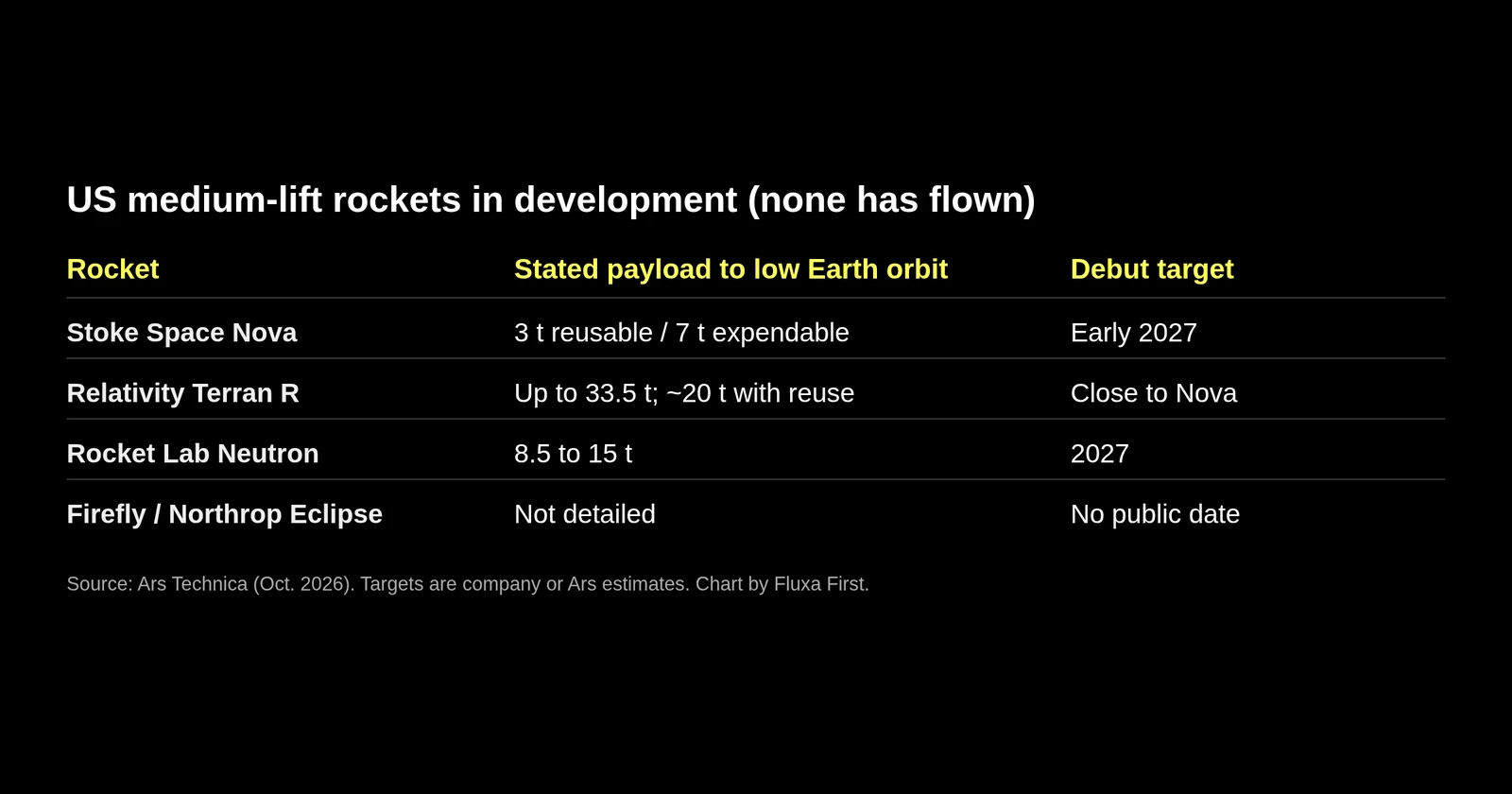
- Four US rockets in or near the medium-lift class are in development (Stoke Nova, Relativity Terran R, Rocket Lab Neutron and Firefly-Northrop Eclipse), and none has flown yet. Launch access is now a core business risk for space startups.
For most of the last decade, getting to orbit was the easy part of a space business plan. That has changed. Recently the Space Force went looking for rides for three national security missions and, according to Politico, found no takers. For space founders and investors, launch access is no longer a line item; it is a strategic risk.
What happened with the Space Force missions?
Politico reported that the Space Force tried to book launches for three future satellite missions through the National Security Space Launch program. According to Politico’s two unnamed sources, SpaceX declined to offer its services, and no other company bid either. Two of the missions were for the Space Development Agency, which is deploying hundreds of military satellites in low Earth orbit for data transport and missile warning and tracking, as Ars Technica summarized.
A senior Space Force acquisition official acknowledged growing pains and said some of it is temporary while new providers come online, while saying he was not worried about being able to fly missions. We read the underlying constraints as more lasting, though. According to Ars, SpaceX has been turning down new Falcon 9 and Falcon Heavy contracts across its customer base. United Launch Alliance and Blue Origin, the other heavy providers, are both working through problems with their vehicles.
Why is there a gap in the market?
Ars Technica’s guide to the US medium-lift race lays out the squeeze. Ars says Falcon 9 is already no longer for sale and that SpaceX plans to pull it from the commercial market as soon as 2028. Vulcan and New Glenn have stacked manifests and are expensive for small and medium satellites. Satellite operators genuinely do not know whom to book with for the 2027 to 2030 period.
Four new US rockets in or near the medium-lift class are meant to fill that gap. None has flown.
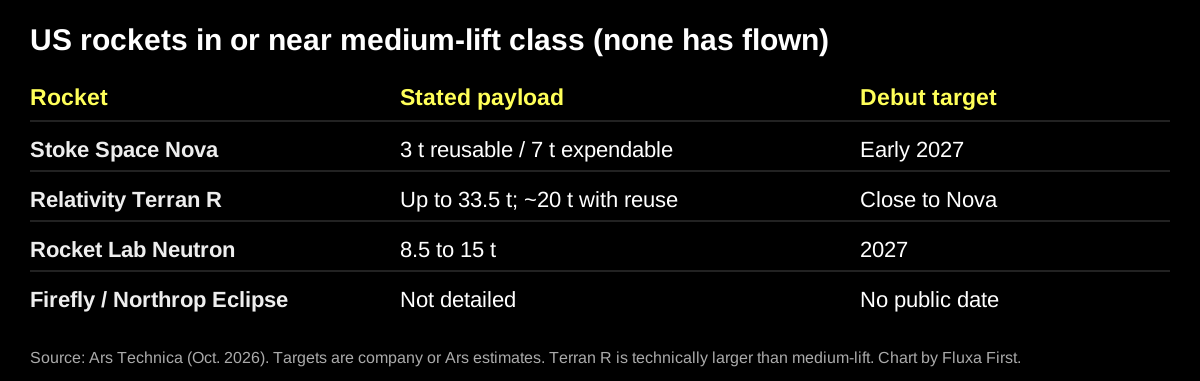
- Stoke Space Nova aims for full reusability, with 3 tons to orbit reusable and 7 tons expendable. Its first stage is nearly complete, and Stoke is targeting early 2027.
- Relativity Terran R advertises up to 33.5 tons expendable, or closer to 20 tons with a reusable first stage. Relativity has completed acceptance testing of all 13 first-stage engines. Ars notes Terran R is technically larger than a medium-lift rocket.
- Rocket Lab Neutron sits between them at 8.5 to 15 tons, with a launch target now in 2027.
- Firefly and Northrop Grumman Eclipse is progressing on its engines, but there is little public detail on the rest of the vehicle.
All four build their own engines in the United States, a sharp contrast with Antares, the last new US medium-lift rocket, which flew with Russian engines and a Ukrainian-built core stage. Ars notes it has been 13 years since that debut.
What does this mean for space startups?
When launch was abundant and cheap, a satellite company’s risk was mostly in the spacecraft and the customer. Now the ride itself is uncertain. We see four practical consequences.
- Launch is a supply chain item with a lead time. Treat it like any scarce component: plan early, qualify alternatives and track it in board meetings.
- Design for more than one vehicle. Spacecraft that can fly on several rockets, or on rideshares and dedicated launches, keep options open. That flexibility costs engineering time up front and saves years later.
- Revenue timing moves with the launch date. Investors should ask how a six- or twelve-month slip changes cash needs. Founders should show that math before they are asked.
- New launch providers become strategic partners. Early customers of new rockets often get better terms and more attention, at the price of first-flight risk. That trade can be worth it if the mission can tolerate it.
There is an opportunity here too. Scarcity raises the value of anything that relieves it: new vehicles, launch sites, ground infrastructure, in-space transport and the suppliers behind them. We covered the ground side of this in our look at launch infrastructure.
How we see it
We think the next few years will reward space companies that treat access to orbit as part of their strategy rather than a purchase order. It also strengthens the case for building a deeper domestic launch base with several providers that each make their own engines, which is good for national security and for the commercial market alike.
For founders, the move is to plan launch the way hardware companies plan critical parts: early, with backups, and with the schedule risk priced in. For investors, the question to ask in every space deal is simple: which rocket, when, and what happens if it slips?
Company plans and dates are as reported in the linked sources and may change. This post is general analysis, not investment advice.
Frequently asked questions
Why is there a launch capacity shortage?
Falcon 9, the workhorse of the market, is no longer taking new contracts as SpaceX shifts toward Starship. The larger Vulcan and New Glenn rockets have had setbacks and have full manifests, and the new rockets meant to fill the gap have not flown yet. Demand from satellite constellations and national security keeps growing in the meantime.
What is a medium-lift rocket?
A rocket with a lift capacity of roughly 2 to 20 metric tons, by the definition Ars Technica uses. That class serves most single satellites and many small constellation batches. The US has not debuted a new medium-lift rocket since Antares, about 13 years ago.
How should a satellite startup plan for launch risk?
Design spacecraft to fit more than one vehicle, book early with more than one provider where possible, budget for delays and price changes, and tell investors plainly how launch timing affects revenue. Treat the launch slot as a supply chain item with a lead time, not as a commodity.