
Space this week: a Phobos launch, a pad rebuild and a partner asking questions
Key takeaways
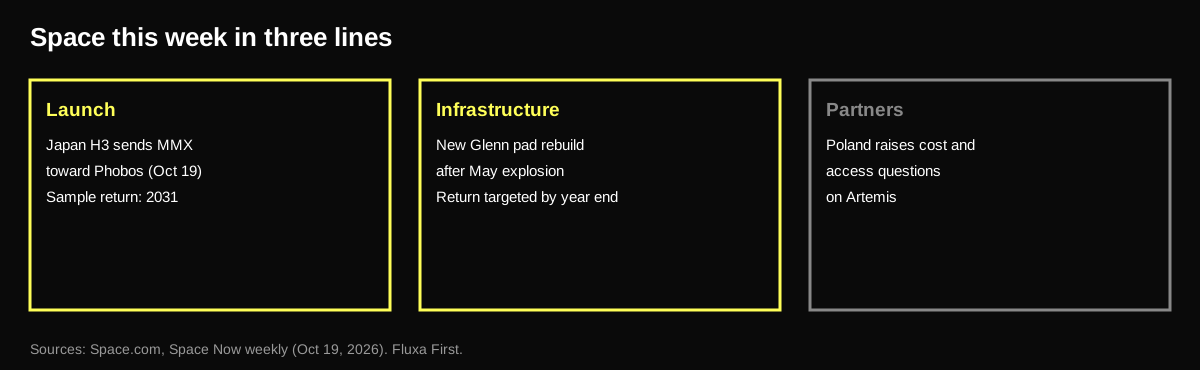
- Japan’s H3 launched the MMX mission on Oct. 19, aiming to return samples from Mars’ moon Phobos in 2031.
- Blue Origin is rebuilding its New Glenn launch pad after a May explosion, targeting a return to flight by year end.
- A European Artemis partner publicly raised concerns about cost, transparency and partner access.
- {‘Our takeaway’: ‘ground infrastructure and partner trust are as strategic as rockets, and both are under-built.’}
This week in space had a historic launch, a reminder of how fragile ground infrastructure is, and a quiet signal about international partnerships. Taken together, they point to the same lesson we keep returning to: the space economy depends on the unglamorous systems around the rocket as much as the rocket itself.
What happened in space this week?
Japan launched MMX toward the moons of Mars. On October 19, JAXA’s Martian Moons eXploration spacecraft lifted off on the tenth flight of Japan’s H3 rocket from Tanegashima, as Space.com reported. The spacecraft should reach Mars in August 2027, study Phobos and Deimos, deploy a small French-German rover, and land twice on Phobos to collect samples. If it succeeds, samples return to Earth in 2031. It is a demanding mission on a rocket that has now flown ten times, and it signals that Japan intends to compete at the high end of deep space.
Blue Origin is rebuilding its New Glenn pad. According to the Space Now weekly briefing, citing NASASpaceflight, Blue Origin is rebuilding Launch Complex 36A at Cape Canaveral after a static-fire explosion in May, and is working toward a New Glenn return to flight by year end. The company has outlined plans for more pads, more upper-stage production and landing ships to raise its flight rate. First it has to get back off this one.
An Artemis partner asked for firmer ground. The same briefing notes that in an October 13 parliamentary response, a Polish deputy minister said Poland remains interested in Artemis while raising concerns about cost, financial transparency and access for international partners, and citing US budget uncertainty as a planning risk.
The surrounding days also carried routine but important work: a cargo Dragon resupply mission launched to the space station on October 13, and the week’s schedule listed a Falcon 9 rideshare and Starlink flights, a Rocket Lab Electron mission and several Chinese launches.
Why do launch pads matter so much?
A modern heavy rocket is only as available as its pad. When a vehicle has one operational launch site and that site is damaged, the whole program pauses: customers wait, revenue slips and the engineering team spends months on concrete, plumbing and tanks instead of flight hardware. Pads, propellant systems, range services and recovery assets are capital intensive and slow to build, and few companies specialize in them.
That makes ground infrastructure a strategic chokepoint for the United States. The country’s launch cadence has grown enormously, but much of it rests on a small number of pads at a small number of ranges. Redundancy is thin. A single anomaly can take a large share of national heavy-lift capacity offline for months.
Why does partner trust matter?
International partners contribute hardware, astronauts, science and money to American-led programs, but those contributions take years to arrange. When a partner publicly questions cost and access, it is a reminder that alliances in space run on predictability. Stable budgets and clear terms are as much a part of space leadership as engines.
Where are the openings for founders?
| Area | Examples of what to build |
|---|---|
| Ground infrastructure | Modular, faster-to-repair pad systems, cryogenic handling, propellant production and storage |
| Range and operations | Scheduling, safety analysis, telemetry and tracking that raise launch throughput |
| Test and qualification | Engine and component test services that shorten the path from build to flight |
| Inspection and resilience | Sensors and analytics that catch pad and vehicle issues before they become failures |
These businesses sell to many launch providers and to government ranges, which spreads the risk across the whole industry instead of tying a startup to one vehicle.
What it means for investors
Space is maturing from a few heroic programs into an industrial supply chain. The returns in mature industries often go to the companies that make everyone else more reliable. We look for space businesses with paying customers today, products that serve more than one vehicle or operator, and capital needs that match their milestones.
Our view
We build in aerospace because access to space is national infrastructure, the same way ports and power plants are. This week showed both the ambition of the field and its weak points. The founders who strengthen the ground beneath the rockets will be building some of the most durable companies in the sector. Learn more about Fluxa First or browse all topics.