
Aircraft parts are now trade leverage. What that means for aerospace supply chains
Key takeaways
- Reuters reported on Oct. 1 that the US Commerce Department slowed export licensing for aircraft parts bound for China and limited parts licensed to planemaker COMAC.
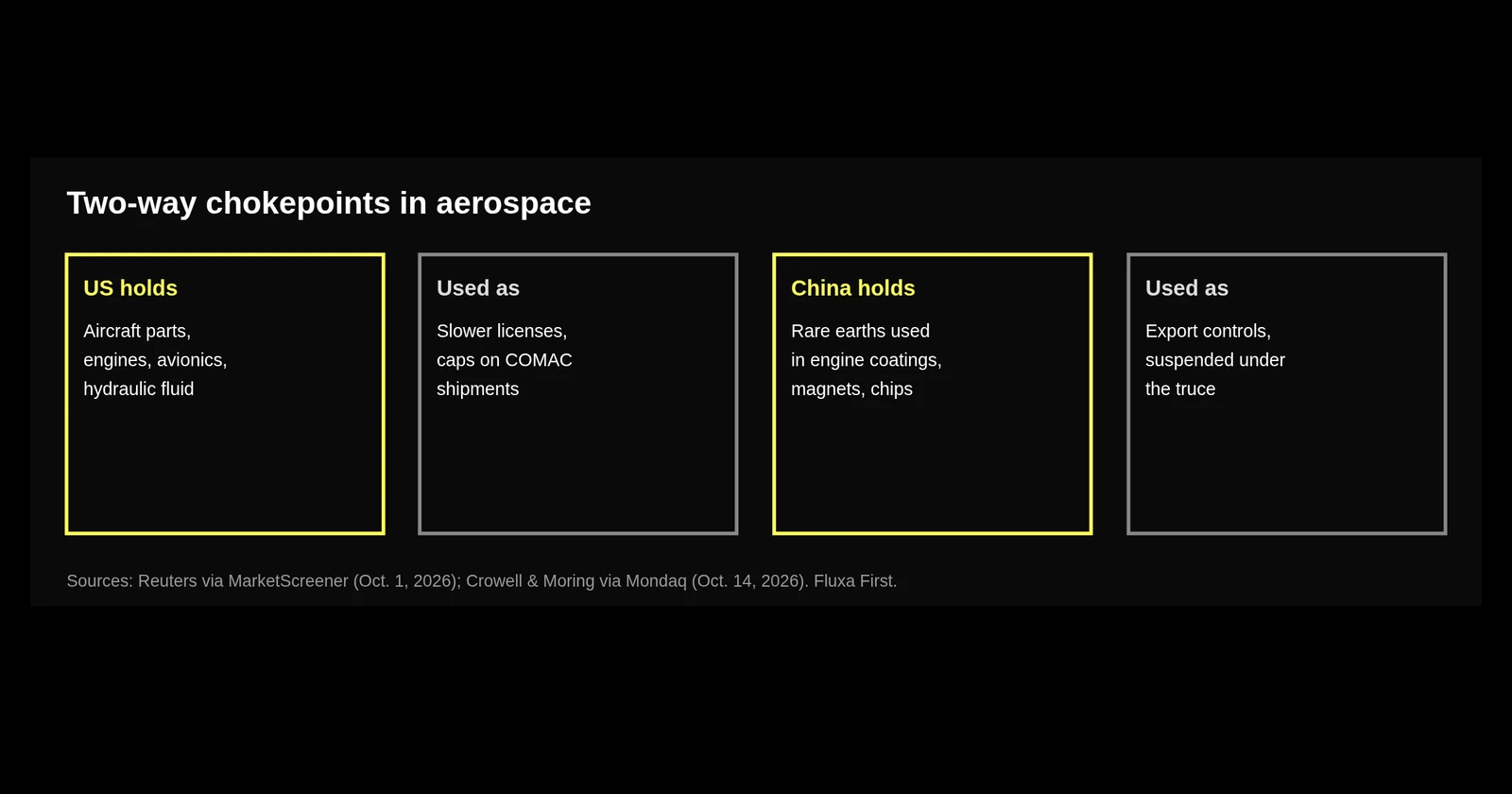
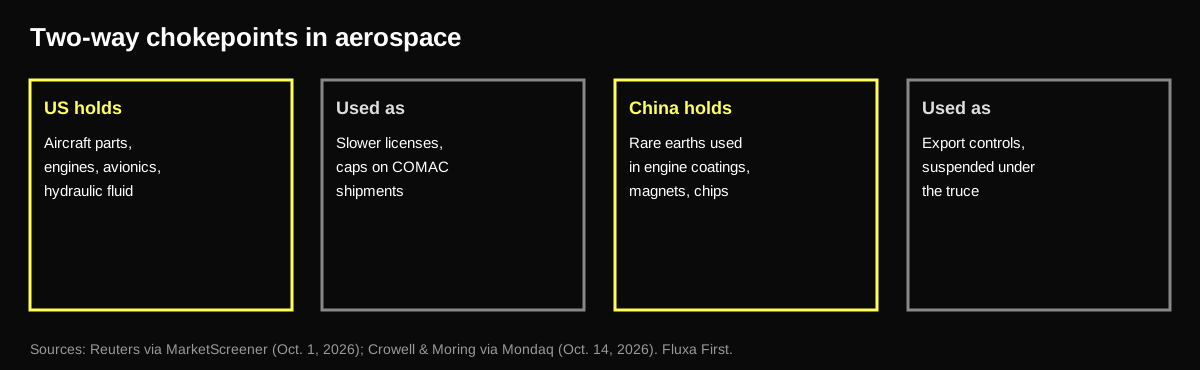
- The move uses China’s dependence on US aviation suppliers as leverage, while China holds leverage of its own through rare earths used in aerospace.
- The US and China announced in September that their trade truce would run to Jan. 10, 2027, but as of late October the US had not formally extended the matching export-rule suspension, which still lapses Nov. 9 without action.
- Aerospace companies should treat export licensing as a business risk and invest in domestic and allied sources for inputs China controls.
Trade fights used to center on tariffs. Increasingly they center on chokepoints: the specific parts, materials and tools one country cannot easily get anywhere else. Aerospace is now one of those battlegrounds, and it cuts both ways. That matters for every company building aircraft, engines or the parts that go into them.
What is the US doing with aircraft parts?
On October 1, Reuters reported, citing people familiar with the matter, that the administration has been turning China’s dependence on US aviation suppliers into leverage for trade talks. According to the report:
- The Commerce Department had slowed export licensing for airplane parts bound for China in the weeks before the report.
- Officials were interested in a regulation that would make it easier to restrict landing gear and other parts, and a draft included a licensing requirement on aviation hydraulic fluid.
- Commerce has been limiting the number of parts licensed for shipment to COMAC, China’s state-owned planemaker, to keep it from stockpiling.
- China has sought several years of spare parts for 200 Boeing jets it agreed to buy, and the US has been reluctant to guarantee them.
This is not the first time. In 2025, the US briefly suspended licenses for GE Aerospace engines, Honeywell navigation systems and other parts for COMAC. ch-aviation noted that the suspension began in late May 2025 and was lifted in early July after a rare earths agreement.
Why does China depend on US suppliers?
Chinese airlines fly Boeing and Airbus jets that need parts from US suppliers, and COMAC’s own aircraft rely heavily on Western systems. ch-aviation reported that COMAC delivered 15 C919s in 2025, well short of an initial target of 75, with production slowed by workforce shortages and foreign supplier delays, and 11 C919s in the first nine months of 2026. COMAC has been trying to reduce its reliance on Western systems, which tells you where it sees its own weak point.
Where is the leverage on the other side?
China holds chokepoints too. The same Reuters report noted that makers of thermal coating sprays used to protect jet engines still struggle with Chinese controls on rare earth materials. We covered China’s rare earth controls and their timeline in an earlier post.
The current truce formalizes that balance. In late September, the two governments announced an extension of their trade truce to January 10, 2027, according to Crowell & Moring. Under the original deal from October 2025, the US suspended its Affiliates Rule, which extends export restrictions to companies at least 50 percent owned by listed entities, and China suspended its rare earth export restrictions. The suspension pushes back, but does not repeal, the US rule. As of late October, Commerce had not published the formal notice extending that suspension past November 9. Both sides’ restrictions remain available to switch back on.
What does this mean for aerospace companies?
We see three practical lessons, whatever one thinks of the policy.
Export licensing is now a business risk. Any supplier with meaningful China revenue, whether in parts, materials or services, should model what happens if licenses slow or stop. That includes inventory, contracts and customer guarantees. Planes are not usually sold with parts guarantees, and this episode shows why some buyers now seek them.
Dependence is leverage, in both directions. The US has leverage in aviation because China depends on its suppliers. The US is exposed where it depends on Chinese inputs, such as rare earths for coatings and magnets. The lasting protection is to reduce your own dependencies, not to count on the other side’s.
Long-run demand may shift. When a country is cut off from parts, it invests in building its own. COMAC’s push to reduce reliance on Western systems may mean fewer export sales over time for Western suppliers, even if near-term business continues.
| Exposure | Question to ask | Mitigation |
|---|---|---|
| China revenue | What if licenses slow for a year? | Diversify customers; plan inventory |
| Chinese inputs | Which parts or materials have no non-Chinese source? | Qualify allied or domestic suppliers now |
| Contracts | Do we promise parts support we may not be allowed to deliver? | Add export-control clauses |
| Long-run demand | Is the customer building a substitute? | Build products tied to allied fleets |
How we see it at Fluxa First
We think the deepest opportunities in aerospace and advanced manufacturing lie in removing chokepoints rather than living with them. Domestic and allied sources for coatings materials, magnets, castings and specialized fluids are not glamorous. They are strategic, and buyers increasingly value them because the alternative is a supply chain that can be switched off during a negotiation.
For founders, this is a reason to design supply chains with the same care as products. Know where every critical input comes from. For investors, it is a reason to value companies that make American and allied industry less exposed. In a world where parts are leverage, reliable supply is a competitive advantage.
This post is analysis, not legal advice. Export control rules change often; check current requirements with counsel.
Frequently asked questions
Is the US restricting aircraft parts exports to China?
According to an October 2026 Reuters report citing people familiar with the matter, the Commerce Department slowed licensing of aircraft parts bound for China and limited the number of parts licensed to COMAC to prevent stockpiling. Officials were also reported to be considering a rule that would make it easier to restrict landing gear and other parts. No formal new rule had been announced in that report.
What is the US-China trade truce?
It is an arrangement first reached in October 2025 in which the US suspended an expansion of its export control rules and China suspended export restrictions on rare earth minerals. In late September 2026 the two sides announced an extension to January 10, 2027, according to a Crowell & Moring analysis; as of late October the Commerce Department had not yet published the formal notice extending its matching rule suspension.